Showing posts with label suv. Show all posts

Sunday, May 5, 2013

2012 Land Rover Range Rove Evoque

-->
It was the middle of fall when a cold, wet, weather system blew in from the Pacific and dumped the season's first significant snow on California's Mammoth Mountain Ski Resort. The next day I received an enthusiastic email from co-worker Karla Sanchez asking to swap cars with me for the weekend so that she could zip to Mammoth Lakes for opening day on the slopes. I obliged but with the agreement she would give me a full report of the Rover's first frolic in foul weather. Here are her observations: 2012 Land Rover Range Rover Evoque Snow Rear Cabin "This is an overall awesome rig to take up to the mountains: It stuck well to the snow-covered surfaces, and rarely felt like it was going to lose traction. Driving at about 50 mph up Minaret Rd, the chassis would occasionally lose grip, but the traction system would quickly actuate, catch and correct any sliding. At one point, I approached a turn too fast and began sliding, but only for a moment, as the tires promptly gripped the snow, allowing the brakes to quickly bring us to a halt. I was a bit nervous pulling into six inches of fresh snow on the driveway of our rental cabin, but the Evoque plowed right through without hesitation. I drove with the snowy/icy surfaces mode engaged most of the time until the end of the weekend when all the snow had melted off the roads. And even then I drove over some large ice patches with the regular mode engaged, but the Evoque glided over them without incident, proving that the stability system is reliable even if the proper mode is not engaged. Room is not very generous inside, either. We had small and large suitcase, a medium duffel, three snowboards, and a few other small bags stacked inside, minimizing the already compromised rearward visibility. My backseat passenger was more then a bit cramped, but be kept his complaints to a minimum, and in fact, over the course of a few days grew to love the car's design and style - his eyes were opened to the benefit of small SUV with lots and lots of luxury amenities. He was also was charmed by the multi lens camera system and thought all the different views were a great novelty. Overall, the Evoque's condensed size and sure-footed stability system make it a great weekend runner to where the payment ends and the lifts begin."
  • 2012 Land Rover Range Rover Evoque Snow Front End 2
  • 2012 Land Rover Range Rover Evoque Snow Front End
  • 2012 Land Rover Range Rover Evoque Snow Front Three Quarter
  • 2012 Land Rover Range Rover Evoque Badge
  • 2012 Land Rover Range Rover Evoque Wheel
  • 2012 Land Rover Range Rover Evoque Start Button
  • 2012 Land Rover Range Rover Evoque Side View
  • 2012 Land Rover Range Rover Evoque Interior
  • 2012 Land Rover Range Rover Evoque Head Light

Our Car
Service Life 8/20,566 miles
Average Fuel Economy 21.7 mpg
CO2 Emissions 0.89 lb/mile
Energy Consumption 155 kW-hr/100 mi
Unresolved problems None
Maintenance cost $0 (oil change, inspection, cabin-air filter, engine-air filter)
Normal-wear cost $0

Saturday, April 27, 2013

2012 BMW 328i Sport car

-->

If you haven't been reading our Car Salesman Confidential series, I recommend it. It's a fascinating look behind the scenes at a dealership and shows how slim the profit margin can be on a new car. The service department, though, is where there's money to be made. I discovered this firsthand when the 328 recently suffered a flat tire while out on a video shoot. The video producer who was driving it had it shipped down to South Bay BMW in Torrance, California, via BMW Roadside Assistance, because the fix-a-flat in the trunk wasn't going to cut it. That's where the trouble started. The car was "lost" for approximately five hours at the dealer -- the tow truck driver had apparently dropped it in a corner somewhere the dealer didn't think to look. Once found, the dealer determined it didn't have an OEM Pirelli Cinturato tire in stock and would have to order one, which meant it wouldn't be fixed on the same day. Never mind that the 3 Series is far and away BMW's best-selling model. A follow-up call to the dealer a day later revealed the car had been "lost" again, but this time for only an hour. 2012 BMW 328I Sport Emergency Lights Two days later, the dealer announced it had successfully installed a new tire. The charge for this service? $500.93. A quick Internet search on my phone showed the retail price for that tire at a place like TireRack.com was just $289. Being a very large dealer, it's unlikely the service department was paying retail price rather than wholesale, but a look at the invoice showed the same tire with a list price of $428.40, a $139.40 markup over bricks-and-mortar retail. After fees and labor were added, it came to $437 before tax. I argued this point with the service consultant, who at first insisted that the service manager set the prices and he had no control over it. When I refused to pay that price, he disappeared for 10 minutes, then returned with a bill for $342.82. The fees for balancing, a valve stem, old tire disposal and a state fee were all still present, but now the tire list price showed $340, and he'd knocked the price down even further to $306 (a supposed loss, based on the numbers presented) and waived the $25 labor charge. (The sales tax went down to $27.32.) Sensing that

Wednesday, April 17, 2013

Tata Indigo

-->
The Tata Indigo is a sedan car manufactured by Tata Motors of India. it is a sedan version

of the Tata Indica, with which it shares a large number of parts.

The Indigo was launched in 2002 by Tata Motors India Limited(TMIL),it is a sedan version of

the Tata Indica, with which it shares a large number of parts.Initially launched with a

Turbo diesel and Petrol engines, An intercooled 'TDI' Engine, and Dicor engines were added

later. A minor redesign was done in 2006 which added dual chamber headlamps and different

bumpers. It was superseded by Tata Indigo Manza in 2009.


Indigo Marina (2004-2010)


The station wagon version called the Indigo Marina (called the Indigo SW in export markets)

was unveiled at the New Delhi Auto Expo 2004.The various advance features embedded to Indigo

Marina variants are front and rear cabin lamp with spot reading lamp, HVAC system, 4 spoke

wheel, aluminum gear shift knob, power windows, body colored bumpers, roof rails, rub rails

on door, full wheel covers, digital clock, retractable luggage cover, side impact beams,

collapsible steering column. As of 2010, the production of the Marina has been cut back, and

the vehicle is no longer readily available in most Tata dealerships.

Indigo XL (2007-present)


The Long Wheel Base Version called the Tata Indigo XL went on sale in January 2007.[1] It is

the long-wheelbase version of the Indigo sedan. It has a 200 mm (7.9 in) stretched wheelbase

and a 101 hp engine.The Petrol model has MPFI 16 valve twin cam engine,whereas the diesel

variant features a DICOR engine developed in-house. Some features are powered front seats

(driver and passenger), rear air conditioning console with separate controls, all four power

windows with auto power down function, and car phone.More to add Tata Indigo XL is also

equipped with excellent high end characteristics like 32 bit microprocessor, 1396 cc, 16

valve engine, Power of 100 PS (74 kW; 99 hp), 200 mm (7.9 in) extended wheelbase, Fuel tank

capacity : 42 L (9.2 imp gal; 11.1 US gal)

Indigo CS (2008-present)


Tata Indigo CS was launched in 2008 at the Auto Expo in New Delhi. "CS" stands for compact

sedan and is claimed to be the world's shortest sedan. The Indigo CS is therefore subjected

to a relatively lower excise duty. There are three models each in petrol and diesel version.

Indigo CS petrol has a 1.2 litre, 65 PS (48 kW; 64 hp), MPFI engine variant and a 1.4 litre

TCIC engine for the diesel version. The Indigo CS was initially launched with the Indica

Grille and Headlights, and with the Indigo Dual chamber headlights and grille in 2009. A

DiCOR option was also added later.

In 2010, it received a new BS-4 compliant Common rail CR4 engine and upgrades in technology

class and design, under the name Indigo CS e-series or Indigo eCS.

Features:- Indigo CS is world's shortest sedan car, size of a hatchback and spaciousness of

a sedan car. Beige interiors, new AC facia, reading lamp, sporty steering wheel, the

instrument panel, New styled Front Grille, front and rear bumper, Soft touch finest quality

seats, Centre Cluster & Air Conditioning Controls, Anti-glare Inner Rear View Mirror, and

trunk space of 380 litres with Independent McPherson struts equipped suspension system.

Tuesday, April 16, 2013

History of Toyota

-->
Toyota Motor Corporation is a car produced company ( Toyota Jidōsha KK?, IPA: [toꜜjota]) /tɔɪˈoʊtə/, abbreviated TMC, is

a Japanese multinational automaker headquartered in Toyota, Aichi, Japan. In 2010, Toyota

employed 300,734 people worldwide, and was the third-largest automobile manufacturer in 2011

by production behind General Motors and Volkswagen Group. Toyota is the eleventh-largest

company in the world by revenue for new car. In July 2012, the company reported it had manufactured its

200-millionth vehicle.

The company was founded by Kiichiro Toyoda in 1937 as a spinoff from his father's company

Toyota Industries to create automobiles. Three years earlier, in 1934, while still a

department of Toyota Industries, it created its first product, the Type A engine, and, in

1936, its first passenger car, the Toyota AA. Toyota Motor Corporation group companies are

Toyota (including the Scion brand), Lexus, Daihatsu, and Hino Motors, along with several

"nonautomotive" companies. TMC is part of the Toyota Group, one of the largest conglomerates

in the world.

Toyota is headquartered in Toyota City, Aichi. Its Tokyo office is located in Bunkyo, Tokyo.

Its Nagoya office is located in Nakamura-ku, Nagoya. In addition to manufacturing

automobiles, Toyota provides financial services through its Toyota Financial Services

division, and also builds robots.

In predominantly Chinese-speaking countries or regions using traditional Chinese characters,

e.g. Hong Kong and Taiwan, Toyota is known as "豊田". In predominantly Chinese-speaking

countries using simplified Chinese characters (e.g. China and Singapore), Toyota is known as

"丰田" (pronounced as "Fēngtián" in Mandarin Chinese and "Hɔng Tshan" in Minnanese). These are

the same characters as the founding family's name "Toyoda" in Japanese, which translate to

"fertile rice paddies" in the Chinese language, as well.
Akio Toyoda, CEO of Toyota, at the annual results press conference, May 11, 2011
Typical breakdown of sales by region

President of Toyota Motor Company:

    Rizaburo Toyoda (1937–1941)
    Kiichiro Toyoda (1941–1950)
    Taizo Ishida (1950–1961)
    Fukio Nakagawa (1961–1967)
    Eiji Toyoda (1967–1981)

In 1981, Toyota Motor Co., Ltd. announced plans to merge with its sales entity Toyota Motor

Sales Co., Ltd. which existed as separate companies since 1950 as a prerequisite for

reconstruction in postwar Japan. Shoichiro Toyoda took the helm at Toyota Motor Sales in

preparation for the consummation of the merger which would occur in 1982 with Shoichiro

succeeding his uncle Eiji as the President of the combined organization, now known as Toyota

Motor Corporation.

President of Toyota Motor Corporation:

    Eiji Toyoda (1981)
    Shoichiro Toyoda (1982–1992)

CEO of Toyota Motor Corporation:

    Dr. Tatsuro Toyoda (1992–1995)
    Hiroshi Okuda (1995–1999)
    Fujio Cho (1999–2005)
    Katsuaki Watanabe (2005–2009)
    Akio Toyoda (2009–present)

Chairman of Toyota Motor Corporation:

    Shoichiro Toyoda (1992–1999)
    Hiroshi Okuda (1999–2006)
    Fujio Cho (2006–present)

Toyota is publicly traded on the Tokyo, Osaka, Nagoya, Fukuoka, and Sapporo exchanges under

company code TYO: 7203. In addition, Toyota is foreign-listed on the New York Stock Exchange

under NYSE: TM and on the London Stock Exchange under LSE: TYT. Toyota has been publicly

traded in Japan since 1949 and internationally since 1999 by new car.

As reported on its consolidated financial statements, Toyota has 540 consolidated

subsidiaries and 226 affiliates.

    Toyota Motor North America (100% – 2004)
    Toyota Canada Inc. owned via Toyota Motor North America
    Toyota Tsusho – Trading company for the Toyota Group
    Daihatsu Motor Company (51.2% – March 31, 2006)
    Hino Motors (50.1% – 2001)
    Lexus 100% (1989)
    Scion 100% (2003)
    DENSO (24.74% – September 30, 2006)
    Toyota Industries (23.51% – March 31, 2006)
    Aisin Seiki Co. (23.0% – September 30, 2006)
    Fuji Heavy Industries (16.66% – June 28, 2008)
    Isuzu Motors (5.9% – November 10, 2006)
    PT Toyota Astra Motor (49% – 2003)
    PT Toyota Motor Manufacturing Indonesia (95% – 2003)

Monday, April 15, 2013

BMW 740i

-->
The 2011 BMW 740i is the 7 Series that new car Goldilocks would have chosen. That is, if she were in
the garage instead of the kitchen and three bears somehow owned BMW's current stable of no
fewer than 15 variations of 7 Series. Sure would beat three measly bowls of porridge.
As she spotted it in the bears' big garage, the 740i would appeal to Goldie's rational side.
It has a six-cylinder engine, so it's frugal at the pump, and it doesn't cost as much to buy
as its V8- and V12-powered brethren. On the other hand, its twin-turbocharged torque would
fire her back into the forest long before the bears came home.

Maybe you should start thinking like Goldilocks, too. Because the thing that makes the 2011
BMW 740i so attractive is that it's "just right." You could drive one car to Trader Joe's and
still bring your own biodegradable bags without feeling ridiculous. And let's face it; you
aren't going autobahn speeds anywhere in the U.S. unless you just love donating to your
state police department anyway.

Old Recipe, New Ingredients


You'll probably recall that this isn't the first time BMW has offered a 7 Series powered by
an inline-6 on our shores. Far from it, as the company started doing so in 1977 before it
had thought of doing a modern V8 engine and then continued into the 1990s. That meant you
could even have a six in the big-bodied E32 cars (remember the 735iL?). Whether you wanted
your 2-ton luxury car to be powered by the noble-but-overworked 208-horsepower inline-6 of
the day was another question altogether, however.

Toss all that aside, though, because Johnny Carson's not at The Tonight Show anymore and
we're not exactly reading the lips of George Bush the Elder these days. The twin-
turbocharged inline-6 in the new F01 body is an entirely new ballgame, as it's pounding out
a conservatively rated 315 hp at 5,800 rpm and 330 pound-feet of torque from 1,500-4,500
rpm.

It's not the first time you've seen this engine, of course. BMW has found tremendous scope
in its turbocharged N54 engine, nestling it under the hood of every model offered, bar the 6
Series and X3. Despite seemingly arbitrary nomenclature car that has nothing to do with
displacement (it's typically a "35i," and here it's a 40i"), the impetus behind the
company's bread-and-butter inline-6 is simple — fuel economy.

You've heard it before. BMW says that the new engine can grunt like an eight-cylinder while
using no more fuel than the standard inline-6. The EPA mpg figures support this assertion,
as the 2011 BMW 740i is rated at 17 mpg city and 25 mpg highway — though as you might
expect, this girl drinks premium only. If these don't seem like astounding fuel-efficiency
figures, bear in mind that the engine is lugging around a full 4,432 pounds with the new-
style F01 body, while that big, bad 750Li returns a less-than-stellar 14 mpg city and 21 mpg
highway.

The Price of Entry


It's hard to use terms like "base model" and "entry-level" when referring to a machine like
the 7 Series, but despite the starting price of $71,025, the 740i is nevertheless such a
thing. There is no massive V12 or twin-turbocharged V8, nor a complicated hybrid system or
all-wheel drive. This is a luxury vehicle with a clean and smooth turbocharged inline-6
powering the rear wheels, and no shortage of amenities.

Subtlety makes the 740i cool. While the big-engine 7s are bedecked with polished brightwork
throughout the cabin, the 740i features more subdued black chrome bits. (We think the car
looks much classier with them.) Almost as a bonus, the rest of the option sheet reads pretty
much the same. Buyers still get niceties like heated leather seats and BMW's reworked iDrive
system.

Check all the boxes and you end up with a loaded 750i — minus the engine. Think of it this
way. You can go to the BMW dealer and plunk down the same amount of cash and decide whether
you want a loaded 7 Series with an inline-6 or a plain 7 Series with a V8. That's why we
hate to call the 740i "entry level."

Size Doesn't Matter

Now here's the thing. BMW has effectively flipped the 7 Series lineup on its head in 2011.
The eco-friendly ActiveHybrid 750i turns out to be one of the fastest flagship cars ever
built, while the lowly 740i returns the exact same fuel economy as the supposed tree-hugger.
More confusing still, the 740i produces the most entertaining drive of all the 7 Series
variants. Allow us to explain.
We're well aware of the fact that the epic V12 in the 760Li packs a full 220 hp more than
our plucky little 740i. And yes, the BMW Alpina B7 is forged in the den of the most
successful BMW tuner to ever walk the earth. But here's where it really counts: The 760Li
weighs more than 680 pounds more than the 740i. Six hundred and eighty! That's not the kind
of weight you can Jenny Craig away, and advanced chassis systems or not, each and every one
of those pounds comes to bear on vehicle dynamics. Yes, the big V12 is plenty quick in a
straight line, but the 740i feels — dare we say — tossable. We've never wanted to wring out
a big sedan  car on a proper track so badly, and that's something that no car in this segment
should have the right to offer.

This car is not 750i fast, but it goes. Despite developing full boost (and torque) by a near
miraculous 1,600 rpm, the twin-turbocharged six does sometimes feel as though it could use
just a little bit more low-end oomph, but it's far from unacceptable. Just allow the tach
needle to continue its steady swing across the tachometer and the 740i picks up speed with
an eerie quickness. Keep your foot on the floorboard and your eyes on the road, and you'll
expect the car to hit redline and shift three times before it finally does, at 7,000 rpm.
BMW claims that 60 mph is dispatched within 5.8 seconds.

Best 7 Series for the Buck

While we try not to make a habit of inciting rage among German engineers and Bimmer fans
worldwide, we're nevertheless awfully tempted to say the BMW 740i is the best 7 Series to
date — or at least the best variant in 2011. The car provides all of the same fuel economy
benefits as the ActiveHybrid 750i without the $32,000 technology surcharge.
And since it weighs less by the margin of two well-fed executives, the 740i is also a hoot
to drive, too. Sure, it doesn't quite offer the kick in the pants of its 7 Series siblings,
but let's face it, the average American 7 Series owner isn't doing much stoplight drag
racing anyway.

The 2011 BMW 740i is the perfect choice for nearly everyone who is considering big luxury,
and exactly what the 7 Series lineup needed to stay innovative and current. It combines
efficiency, luxury and technology without sacrificing the driving dynamics for which BMW is
so renowned. The car is pure BMW in the best way possible.

Sunday, April 14, 2013

BMW E38

-->
The BMW E38 model was the basis for the 1995 through 2001 BMW 7 Series automobiles. In early

1988, development began on the third generation 7-series codenamed "Entwicklung 99". From

1989 to 1991 styling work was done, when Boyke Boyer's concept design was chosen and further

refined into 1992. In August 1992, the final production design for the new 7-series was

approved by the board for production. On April 27, 1993 German design patents were filed

featuring a pre-production prototype as a design representation. Patents were later filed on

October 27, 1993 in the United States. In early 1994, development concluded and in May 1994,

the 1995 E38 BMW 7-Series was unveiled. Production started on February 17, 1994 on pilot

production variants, with series production commencing in the second half of the year.

The E38 models were offered with either a five-speed automatic or manual transmission; 730d,

740d, 740i/iL, and 750i/iL had a 5-speed ZF automatic standard. The engine variants in

Europe were 725tds, 728i, 730i, 730d, 735i, 740i (4.0 and 4.4 L), 740d and 750i. In the

Americas, the models were sold as the 740i, 740iL and 750iL. The 740i/iL were powered by a

4.4 L V8 engine. The base prices in 2001 were US$62,900 for the 740i, US$66,900 for the

740iL and US$92,100 for the 750iL. The considerably rarer 5.4 L V12 was BMW's flagship

vehicle, with a 5.4 L 322 bhp (240 kW; 326 PS) engine, also shared by the Rolls-Royce Silver

Seraph. V8 and V12 cars had long-wheelbase variants, with the "L" added to the designation.

A rare European executive long-wheelbase limousine model was also produced, called the BMW

L7, available as both 740iL (4.4 L V8) and 750iL (5.4 L V12) variants. Protection Line

light-armored vehicles were built from 2000–2001, again utilizing the 740iL and 750iL

platforms, and cost US$99,100 and US$124,400, respectively. These models included body

armor, bullet-resistant glass and run-flat tires.

Features of the E38 7 Series included high-pressure headlight washers, auto-leveling xenon

HID headlamps, power moonroof, a sound system with 14 speakers and four subwoofers as well

as 6-disc CD changer, onboard satellite navigation (1994-1996 MKI based on the VDO-Dayton

Carin system, 1997-2000 MKII based on the Phillips system with separate Trimble Navigation

receiver, 2001 MKIII based on the Phillips system with internal Trimble Navigation receiver.

The E38 7 Series never had the factory DVD-ROM based Navigation system although upgrading to

this system is a simple process) and rain-sensing wipers. Other features included an

automatic climate control system with separate controls for the driver and passenger, a

three-position memory system for the driver’s seat, safety-belt height, new steering wheel

and outside mirrors. Front-seat side airbags and a Head Protection System (HPS) were also

standard. The 750iL featured an all-leather interior with burl walnut trim, while the sport

model featured Sports seats and "Vavona" wood trim . The continuous-motion Active Comfort

Seat technology was introduced in 1998 to improve comfort and reduce fatigue for the driver

and front passenger.


When the E38 was phased out in 2001 to make way for the new E65, sales of E38s increased

noticeably in the car's final months of production as people moved to buy the car before it

was replaced. The E65's radical styling and iDrive were not initially well received by

consumers, so used E38s increased in value as demand increased. Also contributing to the

E38's continued popularity was its appearance in several films such as Tomorrow Never Dies,

The Transporter, Bimmer and The Game. The E38 740i featured in the BMW Film Ambush, even

though it was the only featured car in the series to be replaced the following year.

Hyundai elantra

-->
To my knowledge, no publication had ever conducted a long-term test on a Hyundai so I

decided that the time had come to test the Korean automaker’s mettle. When our silver

Elantra GLS sedan arrived, I gave the team this instruction: Beat on this car has hard as

possible each and every time you drive it.

The Hyundai Elantra  or Hyundai Avante  in South Korea, is a compact car from Hyundai of

South Korea launched in October 1990 for the 1991 model year, and now in its fifth

generation.

The Elantra was formerly marketed as the Lantra in Australia and some European markets. In

Australia, this was due to the similarly named Mitsubishi Magna Elante model. This gave rise

to disagreement from other motor manufacturers, and the name was standardized as "Elantra"

worldwide in 2001 (with the exception being Korea; Malaysia now uses the "Elantra" name,

forsaking the "Avante" of old.

Launched in 1990, the Elantra (codename J1) received a mid-term facelift in 1993.

The Elantra was powered by a Mitsubishi-designed 1.6 L (1596 cc) straight-4 This DOHC 16-

valve 1.6 L unit produced 113 hp (84 kW) at 6000 rpm and could push the Elantra to 60 mph

(97 km/h) in 9.5 seconds. The quarter-mile (0.4 km) run took 17.1 seconds and produced 80

mph (129 km/h). Top speed was 116 mph (187 km/h). The Elantra got 22 mpg[clarification

needed](10.7 L/100 km) in the city cycle. Starting in 1993 there was also a Mitsubishi-

designed 1.8 L (1836 cc) straight-4 engine available the 1.8L unit that produced 124 hp (99

kW) at 6000 rpm.


The Hyundai Elantra was facelifted in 1992 for the European market, adding Hyundai's current

logo to the grille, although North American models retained the previous year's look. In

1993, the vehicle was facelifted again. The third (second in North America) and final

facelift of this generation occurred in 1994 for both front and rear fascias.[citation

needed] The vehicle featured ABS brakes, front airbags, fog lamps, power-operated side

mirrors, and optional alloy 7 spoke wheels.

Thailand lineup are:[citation needed]

    1.5 GL (Manual only)
    1.6 GL (Manual and Automatic)
    1.6 GLS (Manual and Automatic)
    1.8 GT (Manual and Automatic)
    1.8 GTS (Manual and Automatic)

Second generation (1996–2000)
Second generation (J2/RD)
Also called     Hyundai Avante (South Korea)
Hyundai Lantra
Bimantara Nenggala
Production     1995–2000
Model years     1996–2000
Assembly     Ulsan, Korea
Gaborone, Botswana (TMBC)[3]
Body style     4-door sedan
5-door station wagon
Engine     1.5/1.6/1.8/2.0L 89/107/127/140 hp I4 (104 kW)
Transmission     5-speed manual
4-speed automatic
Wheelbase     2,550 mm (100.4 in)
Length     1995–1998 Sedan:4,420 mm (174.0 in)
1995–1998 Wagon:4,450 mm (175.2 in)
1998–2000 Sedan:4,450 mm (175.2 in)
1998–2000 Wagon:4,515 mm (177.8 in)
Width     1995–1998:1,700 mm (66.9 in)
1998–2000:1,735 mm (68.3 in)
Height     1,395 mm (54.9 in)
1998–2000 Wagon:1,460 mm (57.5 in)

Launched in 1995, the second generation (codename RD or J2) was offered as a sedan and

station wagon. It was sold in the South Korean market as the "Hyundai Avante" in sedan form

and "Avante Touring" in the wagon body style. Some export markets such as Australia and

Europe received the series as the "Hyundai Lantra" as per the first generation. Australian

market wagons were titled "Lantra Sportswagon". Between 1996 and 1998, the Elantra was

marketed as the "Bimantara Nenggala" (1.8-liter petrol) in Indonesia.

In Europe, 1996 through 1997 sedan models had carried a silver Mercury-type false grille,

whereas wagon carried no front grille by not featuring this covering.[citation needed]

At launch, a 1.5-litre Alpha SOHC (61 kW or 82 hp) I4 engine and 1.8-litre Beta DOHC (95 kW

or 127 hp) gasoline I4 engine were available on the domestic market. Later, a 1.5-litre

lean-burn(66 kW or 89 hp) gasoline engine based on Alpha DOHC engine was added. The

Philippine version, as well as in some European markets, had the 1.6 (1,599 cc) Beta, DOHC

(G4GR) which produced (84 kW or 113 hp) (in some European markets 66 kW (89 hp))

Range Rover from Land Rover

-->
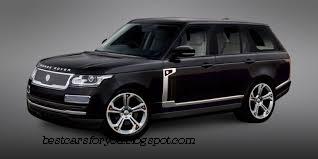
The Range Rover is a large luxury four-wheel drive sport utility vehicle (SUV) produced by
British multinational car maker Land Rover, part of Tata Motors' Jaguar Land Rover group,
and serves as its flagship model. The model, launched in 1970, is now in its fourth
generation. Range Rover is also being developed by Land Rover as its premium brand, and it
is used as a brand name on two other models – the Range Rover Evoque and the Range Rover
Sport.

The Rover Company (the creator of the Land Rover marque) had been experimenting with a
larger model than the Land Rover Series as far back as 1951, when the Rover P4-based two-
wheel-drive "Road Rover" project was developed by Gordon Bashford.This was shelved in 1958,
and the idea lay dormant until 1966, when engineers Spen King and Gordon Bashford set to
work on a new model.

In 1967, the first Range Rover prototype was built, with the classic Range Rover shape
clearly discernible, but with a different front grille and headlight configuration. The
design of the Range Rover was finalised in 1969. Twenty-six Velar engineering development
vehicles were built between 1969 and 1970 and were road registered with the number plates
YVB151H through to YVB177H. The Velar name was derived from the Italian "velare" meaning to
veil or to cover. Range Rover development engineer Geof Miller used the name as a decoy for
registering pre-production Range Rovers. The Velar company was registered in London and
produced 40 pre-production vehicles that were built between 1967 and 1970. Most of these
Velar pre-production vehicles are accounted for and have survived into preservation.
The Range Rover was launched in 1970. In the early 1970s, the Musée du Louvre in Paris
exhibited a Range Rover as an "exemplary work of industrial design".
In 1972, the British Trans-Americas Expedition became the first vehicle-based expedition to
traverse the two American continents from north-to-south, including traversing the roadless
Darién Gap. The specially modified Range Rovers used for this expedition are now on display
in the British Motor Industry Heritage Trust collection at Gaydon, Warwickshire.
Before 1987, Land Rover vehicles were only sold in the United States through the grey
market. The Land Rover company began selling the Range Rover officially in the U.S. on March
16, 1987. From that time until 1993, the U.S. marketing was all in the name of Range Rover,
because it was the only model offered in the American market. In 1993, with the arrival of
the Defender 110 and the imminent arrival of the Land Rover Discovery, the company's U.S.
sales were under the name "Land Rover North America".

In 2005, Land Rover launched another model under the Range Rover brand – the Range Rover
Sport, which was based on the Land Rover Discovery platform.
In 2011, the Range Rover Evoque was launched.

Mercedes-Benz c 01

-->
Do you dream of owning a Mercedes-Benz SLR McLaren, but face a reality where an SL-Class is
more in your price range? Never fear, because Global Imports of Las Vegas is here to help.
For a fee, it can make your everyday SL-500, 550, or 600 look like an SLR McLaren, though
you’ll have to find your own 617-hp supercharged V-8. On the plus side, you can have a
hardtop convertible SLR instead of the rag top for a sleeker look and a quieter ride. Sure,
it’s not the real deal, but it’ll save you a couple hundred grand, so it’s worth
considering.

If you just can’t wait to take advantage of this opportunity, Global Imports is going to
build its C01 and C02 Carbonite cars in-house in Las Vegas using the carbon-fiber kit that’s
built in Germany. If $137,300 for the C01 and the $157,200 for the C02 on the SL550 and
$171,800 for the C01 and $191,700 for the C02 on the SL600 are a bit too much for you to
swallow, you also can bring in any SL500, 550 or 600 you already own and have the
conversions done for $39,800 for the C01 and $59,700 for the C02.
What all those hard-earned dollars will get you in the C01 version is a hood and front and
rear spoilers, all made out of carbon-fiber. You’ll also get a Sport Suspension that will
lower the car 1.0 in. and 20-in. wheels by either Mandrus or Lorinser all around. Up front,
they’ll be wrapped in 255/30 ZR 20 rubber and 305/25 ZR 20 in the rear. Spring for the C02
kit and you’ll also get Carbonite mirrors and “wing” doors that open like those on the SLR
McClaren.

While browsing the SL-Carbonite Web site, we couldn’t help but notice this little gem, what
appears to be a mid-engine supercar called the Sirius. For now, there are only pictures, no
details, but we’ll keep an eye on it and report back any progress we find.

Saturday, April 13, 2013

BMW 7-series

If BMW’s philosophy for the 3-series is “the best sports sedan we can make,” the strategy for the 7-series may well be “just cram in everything we have.” But it’s been a long four years since the current 7 was introduced, and in the meantime BMW has acquired, invested in, developed, built, or invented so much more, er, stuff. It’s all headed for the 7-series this summer, along with some very subtle visual changes.

New car  for Everyone, Except the Billionaires


Other than the V-12–powered 760Li, every 7-series model will see significant upgrades to its powertrain. The 750i (and long-wheelbase 750Li) still use a twin-turbo 4.4-liter V-8, but BMW has added Valvetronic—its variable valve timing and lift system—to this engine. It helps pump up output from last year’s 400 hp and 450 lb-ft of torque to 445 and 480.

The six-cylinder 740i and 740Li models also were sent to the operating room, emerging with the newer version of BMW’s turbocharged inline-six underhood. Power and torque stay at 315 hp and 330 lb-ft, but BMW says it expects the single-turbo N55 engine to improve upon the fuel economy of the outgoing twin-turbo N54. BMW has replaced virtually every N54 in its lineup with the N55 during the past year or so, but we haven’t noticed major fuel-economy improvements in the cars we have tested.

Every 7-series model—yes, even the V-12 cars—now features an eight-speed automatic transmission in place of six-speed boxes. There are some other, less-headline-worthy upgrades car: The eight- and six-cylinder cars now have standard stop-start systems to shut down the engine when the car is at a standstill. A self-flagellation system, called “Eco Pro,” has been added to the range of Driver Dynamics Control settings; it has the power to transform an ordinary 7-series into a Prius, strangling throttle response and shutting off the heating or air conditioning while stopped. Eco Pro also decouples the engine from the rest of the driveline when coasting at speeds between 30 and 100 mph. Finally, all-wheel drive now is available on the long-wheelbase version of the six-cylinder 7-series. In the past, it was offered just for the 750i and 750Li.


The outgoing 7-series hybrid was not a winner. It was often unpleasant to drive, and was positioned more like Lexus’s LS600hL, aiming to give V-12 performance with V-8 consumption. BMW has binned the whole system for the 7, fortunately, and the new ActiveHybrid 7 seems to make more sense. This new car gas-electric setup—available only in long-wheelbase configuration—is essentially the same as is used in the hybrid versions of the 3- and 5-series, pairing the N54 twin-turbo inline-six to an electric motor and an eight-speed automatic transmission. Combined output is 349 hp and 367 lb-ft of torque, down from the previous hybrid’s 455 hp and 515 lb-ft. Fuel-economy ratings aren’t out yet, but BMW says that in European testing the hybridized 7-series delivered a 14-percent improvement over a six-cylinder 740i.

Suspension, Steering, and Everything Else

There are, quite frankly, so many mechanical modifications and new gadgets for the refreshed 7-series that we’d need to buy a new computer server to list the rest of them. Here are some selected highlights:

● Active Roll Stabilization now is standard on the 760Li and continues to be optional on the rest of the range; it aims to mitigate body roll through active front and rear anti-roll bars.

● A self-leveling rear air suspension is now standard across the board; such a suspension was previously available only on long-wheelbase eight- and twelve-cylinder models.

● Adaptive LED headlights are now available and come standard on the 760Li; these replace the adaptive xenon headlights.

● The iDrive navigation and infotainment system has been updated to the latest spec.

● BMW’s Parking Assistant now is available; this feature uses ultrasonic sensors to find a parking space large enough for the 7 and handles steering the car into the space. You know, if you’re afraid of parallel parking.

Friday, April 12, 2013

Land Rover

-->

Land Rover is a British car manufacturer with its headquarters in Gaydon, Warwickshire, United Kingdom which specialises in four-wheel-drive vehicles. It is part of the Jaguar Land Rover group, a subsidiary of Tata Motors of India.It is the second oldest four-wheel-drive car brand in the world (after Jeep). The Land Rover name was originally used by the Rover Company for one specific vehicle model, named simply the Land Rover, launched by Rover in 1948. Over the following years it developed into a marque encompassing a range of four-wheel-drive models, including the Defender, Discovery, Freelander, Range Rover, Range Rover Sport and Range Rover Evoque. Land Rovers are currently assembled in the company's Halewood and Solihull plants, with research and development taking place at JLR's Gaydon and Whitley engineering centres. Land Rover sold 194,000 vehicles worldwide in 2009. Although the brand originates from the original 1948 model, Land Rover as a company has only existed since 1978. Prior to this, it was a product line of the Rover Company which was subsequently absorbed into the Rover-Triumph division of the British Leyland Motor Corporation (BL) following Leyland Motor Corporation’s takeover of Rover in 1967. The ongoing commercial success of the original Land Rover series models, and latterly the Range Rover in the 1970s in the midst of BL’s well documented business troubles prompted the establishment of a separate Land Rover company but still under the BL umbrella, remaining part of the subsequent Rover Group in 1988, under the ownership of British Aerospace after the remains of British Leyland were broken up and privatised. In 1994 Rover Group plc was acquired by BMW. In 2000, Rover Group was broken-up by BMW and Land Rover was sold to Ford Motor Company, becoming part of its Premier Automotive Group. In 2006 Ford purchased the Rover brand from BMW for around £6 million. This reunited the Rover and Land Rover brands for the first time since 2000 when the Rover group was broken up by BMW. In June 2008, Ford sold both Land Rover and Jaguar Cars to Tata Motors. This sale also included the dormant Rover brand. The design for the original Land Rover vehicle was started in 1947 by Maurice Wilks, chief designer at the Rover Company, on his farm in Newborough, Anglesey. It is said that he was inspired by an American World War II Jeep that he used one summer at his holiday home in Wales. The first Land Rover prototype, later nicknamed 'Centre Steer', was built on a Jeep chassis and axles. The early choice of colour was dictated by military surplus supplies of aircraft cockpit paint, so early vehicles only came in various shades of light green; all models until recently feature sturdy box section ladder-frame chassis. The early vehicles, such as the Series I, were field-tested at Long Bennington and designed to be field-serviced; advertisements for Rovers cite vehicles driven thousands of miles on banana oil. Now with more complex service requirements this is less of an option. The British Army maintains the use of the mechanically simple 2.5-litre four-cylinder 300TDi- engined versions rather than the electronically controlled 2.5-litre five-cylinder TD5 to retain some servicing simplicity. This engine also continued in use in some export markets using units built at a Ford plant in Brazil, where Land Rovers were built under license and the engine was also used in Ford pick-up trucks built locally. Production of the TDi engine ended in the United Kingdom in 2006, meaning that Land Rover no longer offers it as an option. International Motors of Brazil offer an engine called the 2.8 TGV Power Torque, which is essentially a 2.8-litre version of the 300TDi, with a corresponding increase in power and torque. During its ownership by Ford, Land Rover was once again associated with Jaguar - the first time the two companies had been under the same ownership since the British Leyland era. In many countries they shared a common sales and distribution network (including shared dealerships), and some models shared components and production facilities. Sale to Tata

sport utility vehicle (SUV)

-->
A sport utility vehicle (SUV) is a vehicle similar to a station wagon or estate car, usually equipped with four-wheel drive for on- or off-road ability. Some SUVs include the towing capacity of a pickup truck with the passenger-carrying space of a minivan or large sedan. Since SUVs are considered light trucks in North America, and often share the same platform with pick-up trucks, at one time, they were regulated less strictly than passenger cars under the two laws in the United States, the Energy Policy and Conservation Act for fuel economy, and the Clean Air Act for emissions.[1] Starting in 2004, the United States Environmental Protection Agency (EPA) began to hold sport utility vehicles to the same tailpipe emissions standards as cars. The term is not used in all countries, and outside North America the terms "off-road vehicle", "four-wheel drive" or "four-by-four" (abbreviated to "4WD" or "4×4") or simply use of the brand name to describe the vehicle like "Jeep" or "Land Rover" are more common. Not all SUVs have four-wheel drive capabilities, and not all four-wheel-drive passenger vehicles are SUVs. Although some SUVs have off-road capabilities, they often play only a secondary role, and SUVs often do not have the ability to switch among two-wheel and four-wheel-drive high gearing and four-wheel-drive low gearing. While automakers tout an SUV's off-road prowess with advertising and naming, the daily use of SUVs is largely on paved roads. Popular in the late-1990s and early–mid-2000s, SUVs sales have since declined due to high oil prices and a declining economy. The traditional truck-based SUV is gradually being supplanted by the crossover SUV, which uses an automobile platform for lighter weight and better fuel efficiency, as a response to much of the criticism of sport utility vehicles. But by 2010, SUV sales around the world recovered, in spite of high gas prices. Although designs vary, SUVs have historically been mid-size passenger vehicles with a body- on-frame chassis similar to that found on light trucks. Early SUVs were mostly two-door models, and were available with removable tops. However, consumer demand pushed the SUV market towards four doors, by 2002 all full-size two-door SUVs were gone from the market. Two-door SUVs were mostly carry-over models, and their sales were not viable enough to warrant a redesign at the end of their design cycle. The Jeep Wrangler remained as a compact two-door body style, although it was also joined by a four-door variant starting with the 2007 model year, the Wrangler Unlimited.[3] The number of two-door SUV models increased in the 2010s with the release of the Range Rover Evoque and the Nissan Murano convertible, although both vehicles are unibody. Most SUVs are designed with an engine compartment, a combined passenger and cargo compartment, and no dedicated trunk such as in a station wagon body. Most mid-size and full -size SUVs have three rows of seats with a cargo area directly behind the last row of seats. Cargo barriers are often fitted to the cargo area to protect the vehicles occupants from injury from unsecured cargo in the event of sudden deceleration or collision. SUVs are known for high ground clearance, upright, boxy body, and high H-point. This can make them more likely to roll over due to their high center of gravity. Bodies of SUVs have recently become more aerodynamic, but the sheer size and weight keeps their fuel economy poor.
Related Posts Plugin for WordPress, Blogger...