Showing posts with label range rover. Show all posts

Tuesday, May 7, 2013

2014 Porsche 911 Turbo/Turbo S

-->

Ever since its debut in 1974, the Porsche 911 Turbo has symbolized extreme performance (beaten only by the completely bonkers GT2). While the original 930 was an absolute handful to drive because of its massive turbo lag and propensity for oversteer, force-fed 911 Turbos have grown quite compliant over the years while producing increasingly mind-blowing performance numbers. 2014 Porsche 911 Turbo S Rear Three Quarters At first glance, the 991 2014 911 Turbo doesn't appear to be that big of an improvement over the 997. Output from the 3.8-liter twin-turbo flat-six goes up by 20 hp and 7 lb-ft to 520 and 487, respectively. The Turbo S gets a 30-hp bump to 560 from the 997's 530, but torque is unchanged at 516 lb-ft. Curb weight of both remains at slightly over 3500 pounds, with the Turbo S closer to 3550 pounds. One big powertrain change is the departure of the manual transmission, with all 2014 911 Turbos offered exclusively with Porsche's seven-speed PDK twin-clutch automatic. Purists may balk, but even the most skilled drivers will be hard-pressed to hit the claimed 0-60 marks of 3.2 seconds (Turbo) and 2.7 seconds (Turbo S) without the PDK's lightning-quick shifts.
  • 2014 Porsche 911 Turbo S Interior
  • 2014 Porsche 911 Turbo S Instrument Cluster
  • 2014 Porsche 911 Turbo S Rear End
Speaking of those performance numbers, the last 997 911 Turbo we tested needed 3 seconds flat, and the last Turbo S went into Veyron territory by hitting 60 in just 2.7 seconds, beating Porsche's estimates. We wouldn't be surprised if we saw 2.5 seconds out of the 2014 Turbo S -- aside from being astounded by just how quick that is. Quarter-mile times should be similarly jaw-dropping -- we saw 10.9 seconds from the 2012 Turbo S and 11.2 seconds for the 2010 Turbo, which was equipped with a manual rather than a PDK. Claimed top speeds are 196 mph for the Turbo and 198 mph for the Turbo S. Handling performance should increase as well, with the 2014s fitted with active aerodynamics (a three-stage front spoiler and deployable rear wing with three positions), rear-wheel steering, and the new Porsche Traction Management all-wheel-drive system, which can send more power to the front wheels than before. The 991s also get

Wednesday, May 1, 2013

2012 Land Rover Range Rover Evoque

-->
A friend of mine recently bought a 2012 Toyota FJ, and knowing that my current daily driver was some sort of Range Rover, he asked if I'd meet him in Death Valley for a weekend of deep canyon exploring. I agreed, but reminded him that this Range Rover is not quite as capable as its bigger brothers, and that his FJ would likely have to take lead when the going got tough. 2012 Land Rover Range Rover Evoque Front Three Quarter 3 Death Valley is a huge place filled with layers and layers of desert grandeur, lots of which can be accessed by well-kept, twisty ribbons of asphalt. These roads are perfect for zipping up and over with the Evoque's sticky rubber and grip-happy suspension, but I wondered how those same tires and suspension would do when we'd leave the asphalt? Our destination was the Barker Ranch via the Goler Wash. Getting to the mouth of the wash meant slithering down a fast, gravel-compacted road, then driving a few miles up a large alluvial fan to the start of the canyon. The Evoque handled all with ease but not without audible fuss. The low-profile tires result in plenty of rough road noise drumming into the cabin -- the price you pay for such big rims. 2012 Land Rover Range Rover Evoque Rear Three Quarter 2 As we neared the mouth of the canyon, I began to notice that the terrain looked recently disturbed. Sure enough, the canyon was completely washed out. Two weeks prior to our arrival, a strong thunderstorm appeared to have wreaked havoc on the canyon, allowing Goler Wash to live up to its name. The Evoque wasn't about to go up it, and even the more capable FJ began to shiver in its boots. Rather then risking getting stuck, we instead used the newly created terrain at the mouth of the canyon to learn more about Evoque's Terrain Response System. Toggling through the settings, then rolling through the boulders and sand allowed my spotters to see how each setting tackles the terrain with a different approach. Though none of the setting were going to change the Evoque's lack of robust tire tread or underbody clearance, I now have a better understanding of the sort of terrain the Evoque is capable of tackling. An FJ it is not, but it's ability to click off triple digit speeds on the asphalt while also zipping down the majority of unpaved roads makes it a unique crossover offering and (mostly) perfect for visiting a big, vast place like Death Valley.

Sunday, April 14, 2013

BMW E38

-->
The BMW E38 model was the basis for the 1995 through 2001 BMW 7 Series automobiles. In early

1988, development began on the third generation 7-series codenamed "Entwicklung 99". From

1989 to 1991 styling work was done, when Boyke Boyer's concept design was chosen and further

refined into 1992. In August 1992, the final production design for the new 7-series was

approved by the board for production. On April 27, 1993 German design patents were filed

featuring a pre-production prototype as a design representation. Patents were later filed on

October 27, 1993 in the United States. In early 1994, development concluded and in May 1994,

the 1995 E38 BMW 7-Series was unveiled. Production started on February 17, 1994 on pilot

production variants, with series production commencing in the second half of the year.

The E38 models were offered with either a five-speed automatic or manual transmission; 730d,

740d, 740i/iL, and 750i/iL had a 5-speed ZF automatic standard. The engine variants in

Europe were 725tds, 728i, 730i, 730d, 735i, 740i (4.0 and 4.4 L), 740d and 750i. In the

Americas, the models were sold as the 740i, 740iL and 750iL. The 740i/iL were powered by a

4.4 L V8 engine. The base prices in 2001 were US$62,900 for the 740i, US$66,900 for the

740iL and US$92,100 for the 750iL. The considerably rarer 5.4 L V12 was BMW's flagship

vehicle, with a 5.4 L 322 bhp (240 kW; 326 PS) engine, also shared by the Rolls-Royce Silver

Seraph. V8 and V12 cars had long-wheelbase variants, with the "L" added to the designation.

A rare European executive long-wheelbase limousine model was also produced, called the BMW

L7, available as both 740iL (4.4 L V8) and 750iL (5.4 L V12) variants. Protection Line

light-armored vehicles were built from 2000–2001, again utilizing the 740iL and 750iL

platforms, and cost US$99,100 and US$124,400, respectively. These models included body

armor, bullet-resistant glass and run-flat tires.

Features of the E38 7 Series included high-pressure headlight washers, auto-leveling xenon

HID headlamps, power moonroof, a sound system with 14 speakers and four subwoofers as well

as 6-disc CD changer, onboard satellite navigation (1994-1996 MKI based on the VDO-Dayton

Carin system, 1997-2000 MKII based on the Phillips system with separate Trimble Navigation

receiver, 2001 MKIII based on the Phillips system with internal Trimble Navigation receiver.

The E38 7 Series never had the factory DVD-ROM based Navigation system although upgrading to

this system is a simple process) and rain-sensing wipers. Other features included an

automatic climate control system with separate controls for the driver and passenger, a

three-position memory system for the driver’s seat, safety-belt height, new steering wheel

and outside mirrors. Front-seat side airbags and a Head Protection System (HPS) were also

standard. The 750iL featured an all-leather interior with burl walnut trim, while the sport

model featured Sports seats and "Vavona" wood trim . The continuous-motion Active Comfort

Seat technology was introduced in 1998 to improve comfort and reduce fatigue for the driver

and front passenger.


When the E38 was phased out in 2001 to make way for the new E65, sales of E38s increased

noticeably in the car's final months of production as people moved to buy the car before it

was replaced. The E65's radical styling and iDrive were not initially well received by

consumers, so used E38s increased in value as demand increased. Also contributing to the

E38's continued popularity was its appearance in several films such as Tomorrow Never Dies,

The Transporter, Bimmer and The Game. The E38 740i featured in the BMW Film Ambush, even

though it was the only featured car in the series to be replaced the following year.

Range Rover from Land Rover

-->
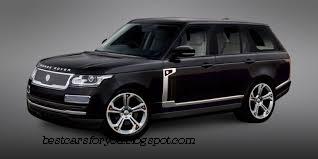
The Range Rover is a large luxury four-wheel drive sport utility vehicle (SUV) produced by
British multinational car maker Land Rover, part of Tata Motors' Jaguar Land Rover group,
and serves as its flagship model. The model, launched in 1970, is now in its fourth
generation. Range Rover is also being developed by Land Rover as its premium brand, and it
is used as a brand name on two other models – the Range Rover Evoque and the Range Rover
Sport.

The Rover Company (the creator of the Land Rover marque) had been experimenting with a
larger model than the Land Rover Series as far back as 1951, when the Rover P4-based two-
wheel-drive "Road Rover" project was developed by Gordon Bashford.This was shelved in 1958,
and the idea lay dormant until 1966, when engineers Spen King and Gordon Bashford set to
work on a new model.

In 1967, the first Range Rover prototype was built, with the classic Range Rover shape
clearly discernible, but with a different front grille and headlight configuration. The
design of the Range Rover was finalised in 1969. Twenty-six Velar engineering development
vehicles were built between 1969 and 1970 and were road registered with the number plates
YVB151H through to YVB177H. The Velar name was derived from the Italian "velare" meaning to
veil or to cover. Range Rover development engineer Geof Miller used the name as a decoy for
registering pre-production Range Rovers. The Velar company was registered in London and
produced 40 pre-production vehicles that were built between 1967 and 1970. Most of these
Velar pre-production vehicles are accounted for and have survived into preservation.
The Range Rover was launched in 1970. In the early 1970s, the Musée du Louvre in Paris
exhibited a Range Rover as an "exemplary work of industrial design".
In 1972, the British Trans-Americas Expedition became the first vehicle-based expedition to
traverse the two American continents from north-to-south, including traversing the roadless
Darién Gap. The specially modified Range Rovers used for this expedition are now on display
in the British Motor Industry Heritage Trust collection at Gaydon, Warwickshire.
Before 1987, Land Rover vehicles were only sold in the United States through the grey
market. The Land Rover company began selling the Range Rover officially in the U.S. on March
16, 1987. From that time until 1993, the U.S. marketing was all in the name of Range Rover,
because it was the only model offered in the American market. In 1993, with the arrival of
the Defender 110 and the imminent arrival of the Land Rover Discovery, the company's U.S.
sales were under the name "Land Rover North America".

In 2005, Land Rover launched another model under the Range Rover brand – the Range Rover
Sport, which was based on the Land Rover Discovery platform.
In 2011, the Range Rover Evoque was launched.
Related Posts Plugin for WordPress, Blogger...