Showing posts with label car. Show all posts

Saturday, April 27, 2013

2012 Nissan Frontier 4X4 PRO4X

-->
Another month gone and another month with nearly 2000 more miles added to our midsize hauler. With so many miles under our lightweights' belt, staffers have noted the manual transmission is starting to whine more. Associate editor Scott Evans took our Nissan Frontier home for the weekend: "There are really only two things I'd change about this truck. First, they've got to tone-down the gear noise. I realize it's a truck, but I've heard race cars with straight-cut gears that didn't make as much racket as the transmission in this truck." 2012 Nissan Frontier 4X4 PRO4X Rear Three Quarters "Second, they've got to update the styling of the dash, console, and door panels. It looks straight out of 2003 and is desperately in need of a refresh." Evans continues, "They can use the same materials, all the same mounting points and dimensions, keep the seats and the rest. Just make it look new like they do to the grille every few years. Everything else can stay." "This truck feels right-size to me. Full-size trucks have gotten so tall and so large they're impractical if you live any place denser than a suburb. This one feels nimble enough to get around a city and still rugged enough to tackle a trail. The tall seating position, manual transmission and 4x4 stickers on the bed make me want to prerun it on the nearest dirt road. It certainly feels robust enough to take the abuse. It's got good power, good clearance and it's not too big or too heavy for moderate obstacles." After a Vegas road trip and daily commutes, our Frontier is nearing its 15000-mile checkup. We'll have more on that update next month when we take it into our local dealer for its second routine maintenance service.
  • 2012 Nissan Frontier 4X4 PRO4X Dash
  • 2012 Nissan Frontier 4X4 PRO4X Back Seats
  • 2012 Nissan Frontier 4X4 PRO4X Radio
  • 2012 Nissan Frontier 4X4 PRO4X Dash Guages
  • 2012 Nissan Frontier 4X4 PRO4X Dash View

2012 Nissan Frontier 4X4 PRO4X
Service life:6 mo/13,732 mi
Avg CO2:1.11 lb/mi
Energy cons:194 kW-hr/100mi
Unresolved problems:None
Maintenance cost:$173.63 (oil change, rotate tires, inspection)
Normal-wear cost:$0
EPA City/Hwy/Comb Fuel Econ:15/20/17 mpg
Average Fuel Econ:17.4 mpg

Thursday, April 25, 2013

new vista d90 - new car

-->

Variants LS/GLS LX/GLX VX/GVX D90 VX D90 ZX+
Alloy wheels
Fog Lamps Front and Rear
Infinity Contrast Roof With
Spice Red
Body Color
Only
Stylish Triple Barrel Headlamps
Full wheel caps (For Quadrajet and Safire Engines only)
Internally Adjustable ORVM Manual Electric
Follow-Me-Home Headlamps
Body Coloured Bumpers
Body Coloured ORVM and Door Handles
Chrome Hood Strip
Premium Chrome Weather Strip
Chrome Lining on Bumper, Door Handles and Around Fog Lamps
Body Coloured Rubrails with Chrome Lining

Wednesday, April 24, 2013

BMW X1

-->
The BMW X1 is a compact luxury crossover SUV developed by BMW, and manufactured by BMW and

BMW Brilliance, and marketed worldwide in rear-wheel (sDrive) and all-wheel-drive (xDrive)

configurations. Production followed the debut of a concept version at the 2008 Paris Motor

Show. with series manufacture beginning at the BMW Leipzig plant in October 2009 — followed

by production in Chennai, India (from knock-down kits (CDK)), Shenyang, China, (by BMW-

Brilliance Automotive Ltd) and Kaliningrad, Russia (CDK,with local partner Avtotor).

The X1 shares a similar platform with the BMW X3, based on the platform of the BMW 3 Series

(E91) Touring (wagon). The EPA classifies the vehicle under the Midsize Cars category.

The X1 introduced BMW's N20 engine in its xDrive28i model. The X1 is slightly smaller and

more affordable than the X3.

X1 sDrive20d EfficientDynamics Edition (2011-)


The vehicle was unveiled in International Frankfurt Motor Show (IAA 2011).

X1 sDrive 16d (2012-)


It is a version with reduced engine power.

The vehicle was unveiled in 21st Auto Mobil International Leipzig 2012.
Equipment

The X1 offers a 420 litre cargo volume, which can increase up to 1350 litres of storage

space with the seats folded. For comparison, the 3-Series Touring (E91) has 460 and the X3

(E83) has 480 litres. The backrest in the rear is adjustable in 11 steps and can be divided

in the ratio 40:20:40. The vehicle offers adaptive cruise control, seating positions with

modestly raised H-point seating (marketed as Semi Command Sitting position) and Performance

Control.
Engines

All sDrive models are rear-wheel drive, while xDrive models are all-wheel drive.

Sunday, April 21, 2013

Toyota Premio

-->
The Toyota Premio is a compact sedan sold in Japan by Toyota as designated by Japanese regulations concerning exterior dimensions and engine displacement.

The Premio is an upscale, and more luxurious sedan in comparison to the Toyota Allion sedan, which has a more youthful, and sporting nature, and is also related to the Toyota Avensis, exclusive to Toyota Netz locations. The Premio is exclusive to Japanese Toyota dealerships Toyopet Store, while the Allion is exclusive to Toyota Store locations. Both the Premio and the Allion were introduced at the same time. Wood trim and silver accents gives the Premio an elegant look and it is considered to be a family or executive type car. Appearance modification options made for the Allion are not made or marketed for the Premio.

In terms of class, the Premio is designed to serve as an alternative to the Toyota Camry, which is exclusive to the Toyota Corolla Store locations

Friday, April 19, 2013

Mitsubishi Pajero

-->
The Mitsubishi Pajero (pron.: /pəˈdʒɛroʊ/; Spanish: [paˈxeɾo]; Japanese パジェロ [padʑeɽo]) is a sport

utility car manufactured by Mitsubishi Motors. It was named after Leopardus pajeros, the

Pampas cat which is native to the Patagonia plateau region of southern Argentina.However,

since pajero is an offensive term for "wanker" in Spanish,alternative names have been used

for many markets overseas. It is known as the Mitsubishi Montero (meaning "mountain hunter"

in Spain, India, and the Americas (except Brazil), and as the Mitsubishi Shogun in the

United Kingdom. In Japan, it was sold at a specific retail chain called Car Plaza.

Discontinued in the United States in 2006, the vehicle continues to be sold in the rest of

the world in its fourth-generation iteration.

Thanks to their success, the Pajero, Montero and Shogun names were also applied to other,

mechanically unrelated models, such as the Pajero Mini kei car, the Pajero Junior and Pajero

iO/Pinin mini SUVs, and the Mitsubishi Pajero/Montero/Shogun Sport. Main rivals are the Land

Rover Discovery, Toyota Land Cruiser Prado SWB/LWB and Nissan Patrol.

The first Pajero prototype was unveiled at the Tokyo Motor Show in November 1973. The Pajero

II prototype followed in 1978, five years later. Mitsubishi’s aim was to create more of a

recreational car, not just an SUV.

In January 1983, the first Pajero made its debut at the Paris Dakar Rally, taking first

place in 1985 at only the third attempt. To date, the Pajero is the most successful vehicle

in the Dakar Rally (winning its class 7 out of the last 10 races, and 15 of the full 32

races). This not only gave the Pajero

Toyota Land Cruiser Prado

-->
Toyota Land Cruiser Prado is a mid-size four-wheel drive car in the Toyota Land Cruiser

range produced by the Japanese car maker Toyota Motor Corporation. The Prado is one of the

smaller vehicles in the range.

In Europe it is sold as simply the Toyota Land Cruiser LC3, LC4 or LC5 (depending on the

generation) or with the number series designation (LC 70, LC 90 and LC 120). In North

America it is not part of the Land Cruiser range, being instead sold as the Lexus GX 470,

with nearly identical body panels and a V8 engine.

The current Prado is based on Toyota's J150 platform. Previous models were based on the J70,

J90 and J120 platforms. All models designated Prado feature front independent suspension,

ladder frame and a two-speed transfer case except the J70 which had active diffs front and

rear.

The Toyota Land Cruiser Prado is available in GX, GXL, VX and Grande spec versions. The GX

is the entry level model, while the Grande is the more luxurious version. In most markets it

is available with either a 4.0 L petrol V6 or a 3.0 L Diesel engine. In some European

countries there are commercial van variants, based on the short-wheelbase chassis.

First developed as the light-duty of the 70 Series, in November 1984. Available only in

short body, and there were options for soft top or hard top (metal top). Names like Land

Cruiser II, Land Cruiser, and Bundera were made for these 'Light Duty' Land Cruisers. The

Bundera was a medium wheelbase two-door with a plastic top and barn doors at the rear. There

were three engine options, the 2.4 L (2366 cc) 22R petrol engine and 2.4 L (2446 cc) 2L and

2L-T diesel and turbo diesel engines. Transmission for the gasoline engine is the G52 type

while the diesels used the R150 and R151 types. These were the same engines and transmission

used in 4Runner, in cooperation with Hino the new car.

In April 1990, a new type was introduced. The front grille, front fenders and engine hood

were redesigned. The head lamp design changed as well. At the same time the sub name Prado

was attached, but names like Land Cruiser and Land Cruiser II were still used in other parts

of the world besides Japan. Meaning plain or field in Portuguese, Prado the new car from

Land Cruiser was marketed toward more on-road purposes, despite a body on frame design which

was highly capable off-road.

In Japan it came with electronic fuel injection and a four speed automatic transmission. The

2.4 L turbo diesel engine with 71 kW (97 PS; 95 hp) and 240 N·m

Tuesday, April 16, 2013

History of Toyota

-->
Toyota Motor Corporation is a car produced company ( Toyota Jidōsha KK?, IPA: [toꜜjota]) /tɔɪˈoʊtə/, abbreviated TMC, is

a Japanese multinational automaker headquartered in Toyota, Aichi, Japan. In 2010, Toyota

employed 300,734 people worldwide, and was the third-largest automobile manufacturer in 2011

by production behind General Motors and Volkswagen Group. Toyota is the eleventh-largest

company in the world by revenue for new car. In July 2012, the company reported it had manufactured its

200-millionth vehicle.

The company was founded by Kiichiro Toyoda in 1937 as a spinoff from his father's company

Toyota Industries to create automobiles. Three years earlier, in 1934, while still a

department of Toyota Industries, it created its first product, the Type A engine, and, in

1936, its first passenger car, the Toyota AA. Toyota Motor Corporation group companies are

Toyota (including the Scion brand), Lexus, Daihatsu, and Hino Motors, along with several

"nonautomotive" companies. TMC is part of the Toyota Group, one of the largest conglomerates

in the world.

Toyota is headquartered in Toyota City, Aichi. Its Tokyo office is located in Bunkyo, Tokyo.

Its Nagoya office is located in Nakamura-ku, Nagoya. In addition to manufacturing

automobiles, Toyota provides financial services through its Toyota Financial Services

division, and also builds robots.

In predominantly Chinese-speaking countries or regions using traditional Chinese characters,

e.g. Hong Kong and Taiwan, Toyota is known as "豊田". In predominantly Chinese-speaking

countries using simplified Chinese characters (e.g. China and Singapore), Toyota is known as

"丰田" (pronounced as "Fēngtián" in Mandarin Chinese and "Hɔng Tshan" in Minnanese). These are

the same characters as the founding family's name "Toyoda" in Japanese, which translate to

"fertile rice paddies" in the Chinese language, as well.
Akio Toyoda, CEO of Toyota, at the annual results press conference, May 11, 2011
Typical breakdown of sales by region

President of Toyota Motor Company:

    Rizaburo Toyoda (1937–1941)
    Kiichiro Toyoda (1941–1950)
    Taizo Ishida (1950–1961)
    Fukio Nakagawa (1961–1967)
    Eiji Toyoda (1967–1981)

In 1981, Toyota Motor Co., Ltd. announced plans to merge with its sales entity Toyota Motor

Sales Co., Ltd. which existed as separate companies since 1950 as a prerequisite for

reconstruction in postwar Japan. Shoichiro Toyoda took the helm at Toyota Motor Sales in

preparation for the consummation of the merger which would occur in 1982 with Shoichiro

succeeding his uncle Eiji as the President of the combined organization, now known as Toyota

Motor Corporation.

President of Toyota Motor Corporation:

    Eiji Toyoda (1981)
    Shoichiro Toyoda (1982–1992)

CEO of Toyota Motor Corporation:

    Dr. Tatsuro Toyoda (1992–1995)
    Hiroshi Okuda (1995–1999)
    Fujio Cho (1999–2005)
    Katsuaki Watanabe (2005–2009)
    Akio Toyoda (2009–present)

Chairman of Toyota Motor Corporation:

    Shoichiro Toyoda (1992–1999)
    Hiroshi Okuda (1999–2006)
    Fujio Cho (2006–present)

Toyota is publicly traded on the Tokyo, Osaka, Nagoya, Fukuoka, and Sapporo exchanges under

company code TYO: 7203. In addition, Toyota is foreign-listed on the New York Stock Exchange

under NYSE: TM and on the London Stock Exchange under LSE: TYT. Toyota has been publicly

traded in Japan since 1949 and internationally since 1999 by new car.

As reported on its consolidated financial statements, Toyota has 540 consolidated

subsidiaries and 226 affiliates.

    Toyota Motor North America (100% – 2004)
    Toyota Canada Inc. owned via Toyota Motor North America
    Toyota Tsusho – Trading company for the Toyota Group
    Daihatsu Motor Company (51.2% – March 31, 2006)
    Hino Motors (50.1% – 2001)
    Lexus 100% (1989)
    Scion 100% (2003)
    DENSO (24.74% – September 30, 2006)
    Toyota Industries (23.51% – March 31, 2006)
    Aisin Seiki Co. (23.0% – September 30, 2006)
    Fuji Heavy Industries (16.66% – June 28, 2008)
    Isuzu Motors (5.9% – November 10, 2006)
    PT Toyota Astra Motor (49% – 2003)
    PT Toyota Motor Manufacturing Indonesia (95% – 2003)

Monday, April 15, 2013

BMW 740i

-->
The 2011 BMW 740i is the 7 Series that new car Goldilocks would have chosen. That is, if she were in
the garage instead of the kitchen and three bears somehow owned BMW's current stable of no
fewer than 15 variations of 7 Series. Sure would beat three measly bowls of porridge.
As she spotted it in the bears' big garage, the 740i would appeal to Goldie's rational side.
It has a six-cylinder engine, so it's frugal at the pump, and it doesn't cost as much to buy
as its V8- and V12-powered brethren. On the other hand, its twin-turbocharged torque would
fire her back into the forest long before the bears came home.

Maybe you should start thinking like Goldilocks, too. Because the thing that makes the 2011
BMW 740i so attractive is that it's "just right." You could drive one car to Trader Joe's and
still bring your own biodegradable bags without feeling ridiculous. And let's face it; you
aren't going autobahn speeds anywhere in the U.S. unless you just love donating to your
state police department anyway.

Old Recipe, New Ingredients


You'll probably recall that this isn't the first time BMW has offered a 7 Series powered by
an inline-6 on our shores. Far from it, as the company started doing so in 1977 before it
had thought of doing a modern V8 engine and then continued into the 1990s. That meant you
could even have a six in the big-bodied E32 cars (remember the 735iL?). Whether you wanted
your 2-ton luxury car to be powered by the noble-but-overworked 208-horsepower inline-6 of
the day was another question altogether, however.

Toss all that aside, though, because Johnny Carson's not at The Tonight Show anymore and
we're not exactly reading the lips of George Bush the Elder these days. The twin-
turbocharged inline-6 in the new F01 body is an entirely new ballgame, as it's pounding out
a conservatively rated 315 hp at 5,800 rpm and 330 pound-feet of torque from 1,500-4,500
rpm.

It's not the first time you've seen this engine, of course. BMW has found tremendous scope
in its turbocharged N54 engine, nestling it under the hood of every model offered, bar the 6
Series and X3. Despite seemingly arbitrary nomenclature car that has nothing to do with
displacement (it's typically a "35i," and here it's a 40i"), the impetus behind the
company's bread-and-butter inline-6 is simple — fuel economy.

You've heard it before. BMW says that the new engine can grunt like an eight-cylinder while
using no more fuel than the standard inline-6. The EPA mpg figures support this assertion,
as the 2011 BMW 740i is rated at 17 mpg city and 25 mpg highway — though as you might
expect, this girl drinks premium only. If these don't seem like astounding fuel-efficiency
figures, bear in mind that the engine is lugging around a full 4,432 pounds with the new-
style F01 body, while that big, bad 750Li returns a less-than-stellar 14 mpg city and 21 mpg
highway.

The Price of Entry


It's hard to use terms like "base model" and "entry-level" when referring to a machine like
the 7 Series, but despite the starting price of $71,025, the 740i is nevertheless such a
thing. There is no massive V12 or twin-turbocharged V8, nor a complicated hybrid system or
all-wheel drive. This is a luxury vehicle with a clean and smooth turbocharged inline-6
powering the rear wheels, and no shortage of amenities.

Subtlety makes the 740i cool. While the big-engine 7s are bedecked with polished brightwork
throughout the cabin, the 740i features more subdued black chrome bits. (We think the car
looks much classier with them.) Almost as a bonus, the rest of the option sheet reads pretty
much the same. Buyers still get niceties like heated leather seats and BMW's reworked iDrive
system.

Check all the boxes and you end up with a loaded 750i — minus the engine. Think of it this
way. You can go to the BMW dealer and plunk down the same amount of cash and decide whether
you want a loaded 7 Series with an inline-6 or a plain 7 Series with a V8. That's why we
hate to call the 740i "entry level."

Size Doesn't Matter

Now here's the thing. BMW has effectively flipped the 7 Series lineup on its head in 2011.
The eco-friendly ActiveHybrid 750i turns out to be one of the fastest flagship cars ever
built, while the lowly 740i returns the exact same fuel economy as the supposed tree-hugger.
More confusing still, the 740i produces the most entertaining drive of all the 7 Series
variants. Allow us to explain.
We're well aware of the fact that the epic V12 in the 760Li packs a full 220 hp more than
our plucky little 740i. And yes, the BMW Alpina B7 is forged in the den of the most
successful BMW tuner to ever walk the earth. But here's where it really counts: The 760Li
weighs more than 680 pounds more than the 740i. Six hundred and eighty! That's not the kind
of weight you can Jenny Craig away, and advanced chassis systems or not, each and every one
of those pounds comes to bear on vehicle dynamics. Yes, the big V12 is plenty quick in a
straight line, but the 740i feels — dare we say — tossable. We've never wanted to wring out
a big sedan  car on a proper track so badly, and that's something that no car in this segment
should have the right to offer.

This car is not 750i fast, but it goes. Despite developing full boost (and torque) by a near
miraculous 1,600 rpm, the twin-turbocharged six does sometimes feel as though it could use
just a little bit more low-end oomph, but it's far from unacceptable. Just allow the tach
needle to continue its steady swing across the tachometer and the 740i picks up speed with
an eerie quickness. Keep your foot on the floorboard and your eyes on the road, and you'll
expect the car to hit redline and shift three times before it finally does, at 7,000 rpm.
BMW claims that 60 mph is dispatched within 5.8 seconds.

Best 7 Series for the Buck

While we try not to make a habit of inciting rage among German engineers and Bimmer fans
worldwide, we're nevertheless awfully tempted to say the BMW 740i is the best 7 Series to
date — or at least the best variant in 2011. The car provides all of the same fuel economy
benefits as the ActiveHybrid 750i without the $32,000 technology surcharge.
And since it weighs less by the margin of two well-fed executives, the 740i is also a hoot
to drive, too. Sure, it doesn't quite offer the kick in the pants of its 7 Series siblings,
but let's face it, the average American 7 Series owner isn't doing much stoplight drag
racing anyway.

The 2011 BMW 740i is the perfect choice for nearly everyone who is considering big luxury,
and exactly what the 7 Series lineup needed to stay innovative and current. It combines
efficiency, luxury and technology without sacrificing the driving dynamics for which BMW is
so renowned. The car is pure BMW in the best way possible.

Sunday, April 14, 2013

BMW E38

-->
The BMW E38 model was the basis for the 1995 through 2001 BMW 7 Series automobiles. In early

1988, development began on the third generation 7-series codenamed "Entwicklung 99". From

1989 to 1991 styling work was done, when Boyke Boyer's concept design was chosen and further

refined into 1992. In August 1992, the final production design for the new 7-series was

approved by the board for production. On April 27, 1993 German design patents were filed

featuring a pre-production prototype as a design representation. Patents were later filed on

October 27, 1993 in the United States. In early 1994, development concluded and in May 1994,

the 1995 E38 BMW 7-Series was unveiled. Production started on February 17, 1994 on pilot

production variants, with series production commencing in the second half of the year.

The E38 models were offered with either a five-speed automatic or manual transmission; 730d,

740d, 740i/iL, and 750i/iL had a 5-speed ZF automatic standard. The engine variants in

Europe were 725tds, 728i, 730i, 730d, 735i, 740i (4.0 and 4.4 L), 740d and 750i. In the

Americas, the models were sold as the 740i, 740iL and 750iL. The 740i/iL were powered by a

4.4 L V8 engine. The base prices in 2001 were US$62,900 for the 740i, US$66,900 for the

740iL and US$92,100 for the 750iL. The considerably rarer 5.4 L V12 was BMW's flagship

vehicle, with a 5.4 L 322 bhp (240 kW; 326 PS) engine, also shared by the Rolls-Royce Silver

Seraph. V8 and V12 cars had long-wheelbase variants, with the "L" added to the designation.

A rare European executive long-wheelbase limousine model was also produced, called the BMW

L7, available as both 740iL (4.4 L V8) and 750iL (5.4 L V12) variants. Protection Line

light-armored vehicles were built from 2000–2001, again utilizing the 740iL and 750iL

platforms, and cost US$99,100 and US$124,400, respectively. These models included body

armor, bullet-resistant glass and run-flat tires.

Features of the E38 7 Series included high-pressure headlight washers, auto-leveling xenon

HID headlamps, power moonroof, a sound system with 14 speakers and four subwoofers as well

as 6-disc CD changer, onboard satellite navigation (1994-1996 MKI based on the VDO-Dayton

Carin system, 1997-2000 MKII based on the Phillips system with separate Trimble Navigation

receiver, 2001 MKIII based on the Phillips system with internal Trimble Navigation receiver.

The E38 7 Series never had the factory DVD-ROM based Navigation system although upgrading to

this system is a simple process) and rain-sensing wipers. Other features included an

automatic climate control system with separate controls for the driver and passenger, a

three-position memory system for the driver’s seat, safety-belt height, new steering wheel

and outside mirrors. Front-seat side airbags and a Head Protection System (HPS) were also

standard. The 750iL featured an all-leather interior with burl walnut trim, while the sport

model featured Sports seats and "Vavona" wood trim . The continuous-motion Active Comfort

Seat technology was introduced in 1998 to improve comfort and reduce fatigue for the driver

and front passenger.


When the E38 was phased out in 2001 to make way for the new E65, sales of E38s increased

noticeably in the car's final months of production as people moved to buy the car before it

was replaced. The E65's radical styling and iDrive were not initially well received by

consumers, so used E38s increased in value as demand increased. Also contributing to the

E38's continued popularity was its appearance in several films such as Tomorrow Never Dies,

The Transporter, Bimmer and The Game. The E38 740i featured in the BMW Film Ambush, even

though it was the only featured car in the series to be replaced the following year.

Hyundai elantra

-->
To my knowledge, no publication had ever conducted a long-term test on a Hyundai so I

decided that the time had come to test the Korean automaker’s mettle. When our silver

Elantra GLS sedan arrived, I gave the team this instruction: Beat on this car has hard as

possible each and every time you drive it.

The Hyundai Elantra  or Hyundai Avante  in South Korea, is a compact car from Hyundai of

South Korea launched in October 1990 for the 1991 model year, and now in its fifth

generation.

The Elantra was formerly marketed as the Lantra in Australia and some European markets. In

Australia, this was due to the similarly named Mitsubishi Magna Elante model. This gave rise

to disagreement from other motor manufacturers, and the name was standardized as "Elantra"

worldwide in 2001 (with the exception being Korea; Malaysia now uses the "Elantra" name,

forsaking the "Avante" of old.

Launched in 1990, the Elantra (codename J1) received a mid-term facelift in 1993.

The Elantra was powered by a Mitsubishi-designed 1.6 L (1596 cc) straight-4 This DOHC 16-

valve 1.6 L unit produced 113 hp (84 kW) at 6000 rpm and could push the Elantra to 60 mph

(97 km/h) in 9.5 seconds. The quarter-mile (0.4 km) run took 17.1 seconds and produced 80

mph (129 km/h). Top speed was 116 mph (187 km/h). The Elantra got 22 mpg[clarification

needed](10.7 L/100 km) in the city cycle. Starting in 1993 there was also a Mitsubishi-

designed 1.8 L (1836 cc) straight-4 engine available the 1.8L unit that produced 124 hp (99

kW) at 6000 rpm.


The Hyundai Elantra was facelifted in 1992 for the European market, adding Hyundai's current

logo to the grille, although North American models retained the previous year's look. In

1993, the vehicle was facelifted again. The third (second in North America) and final

facelift of this generation occurred in 1994 for both front and rear fascias.[citation

needed] The vehicle featured ABS brakes, front airbags, fog lamps, power-operated side

mirrors, and optional alloy 7 spoke wheels.

Thailand lineup are:[citation needed]

    1.5 GL (Manual only)
    1.6 GL (Manual and Automatic)
    1.6 GLS (Manual and Automatic)
    1.8 GT (Manual and Automatic)
    1.8 GTS (Manual and Automatic)

Second generation (1996–2000)
Second generation (J2/RD)
Also called     Hyundai Avante (South Korea)
Hyundai Lantra
Bimantara Nenggala
Production     1995–2000
Model years     1996–2000
Assembly     Ulsan, Korea
Gaborone, Botswana (TMBC)[3]
Body style     4-door sedan
5-door station wagon
Engine     1.5/1.6/1.8/2.0L 89/107/127/140 hp I4 (104 kW)
Transmission     5-speed manual
4-speed automatic
Wheelbase     2,550 mm (100.4 in)
Length     1995–1998 Sedan:4,420 mm (174.0 in)
1995–1998 Wagon:4,450 mm (175.2 in)
1998–2000 Sedan:4,450 mm (175.2 in)
1998–2000 Wagon:4,515 mm (177.8 in)
Width     1995–1998:1,700 mm (66.9 in)
1998–2000:1,735 mm (68.3 in)
Height     1,395 mm (54.9 in)
1998–2000 Wagon:1,460 mm (57.5 in)

Launched in 1995, the second generation (codename RD or J2) was offered as a sedan and

station wagon. It was sold in the South Korean market as the "Hyundai Avante" in sedan form

and "Avante Touring" in the wagon body style. Some export markets such as Australia and

Europe received the series as the "Hyundai Lantra" as per the first generation. Australian

market wagons were titled "Lantra Sportswagon". Between 1996 and 1998, the Elantra was

marketed as the "Bimantara Nenggala" (1.8-liter petrol) in Indonesia.

In Europe, 1996 through 1997 sedan models had carried a silver Mercury-type false grille,

whereas wagon carried no front grille by not featuring this covering.[citation needed]

At launch, a 1.5-litre Alpha SOHC (61 kW or 82 hp) I4 engine and 1.8-litre Beta DOHC (95 kW

or 127 hp) gasoline I4 engine were available on the domestic market. Later, a 1.5-litre

lean-burn(66 kW or 89 hp) gasoline engine based on Alpha DOHC engine was added. The

Philippine version, as well as in some European markets, had the 1.6 (1,599 cc) Beta, DOHC

(G4GR) which produced (84 kW or 113 hp) (in some European markets 66 kW (89 hp))

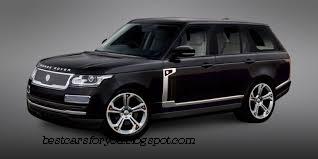
Range Rover from Land Rover

-->
The Range Rover is a large luxury four-wheel drive sport utility vehicle (SUV) produced by
British multinational car maker Land Rover, part of Tata Motors' Jaguar Land Rover group,
and serves as its flagship model. The model, launched in 1970, is now in its fourth
generation. Range Rover is also being developed by Land Rover as its premium brand, and it
is used as a brand name on two other models – the Range Rover Evoque and the Range Rover
Sport.

The Rover Company (the creator of the Land Rover marque) had been experimenting with a
larger model than the Land Rover Series as far back as 1951, when the Rover P4-based two-
wheel-drive "Road Rover" project was developed by Gordon Bashford.This was shelved in 1958,
and the idea lay dormant until 1966, when engineers Spen King and Gordon Bashford set to
work on a new model.

In 1967, the first Range Rover prototype was built, with the classic Range Rover shape
clearly discernible, but with a different front grille and headlight configuration. The
design of the Range Rover was finalised in 1969. Twenty-six Velar engineering development
vehicles were built between 1969 and 1970 and were road registered with the number plates
YVB151H through to YVB177H. The Velar name was derived from the Italian "velare" meaning to
veil or to cover. Range Rover development engineer Geof Miller used the name as a decoy for
registering pre-production Range Rovers. The Velar company was registered in London and
produced 40 pre-production vehicles that were built between 1967 and 1970. Most of these
Velar pre-production vehicles are accounted for and have survived into preservation.
The Range Rover was launched in 1970. In the early 1970s, the Musée du Louvre in Paris
exhibited a Range Rover as an "exemplary work of industrial design".
In 1972, the British Trans-Americas Expedition became the first vehicle-based expedition to
traverse the two American continents from north-to-south, including traversing the roadless
Darién Gap. The specially modified Range Rovers used for this expedition are now on display
in the British Motor Industry Heritage Trust collection at Gaydon, Warwickshire.
Before 1987, Land Rover vehicles were only sold in the United States through the grey
market. The Land Rover company began selling the Range Rover officially in the U.S. on March
16, 1987. From that time until 1993, the U.S. marketing was all in the name of Range Rover,
because it was the only model offered in the American market. In 1993, with the arrival of
the Defender 110 and the imminent arrival of the Land Rover Discovery, the company's U.S.
sales were under the name "Land Rover North America".

In 2005, Land Rover launched another model under the Range Rover brand – the Range Rover
Sport, which was based on the Land Rover Discovery platform.
In 2011, the Range Rover Evoque was launched.

The Audi A1

-->
The Audi A1 (internally designated Typ 8X) is a supermini sized economical car launched by
Audi at the 2010 Geneva Motor Show. Sales of the initial three door A1 model started in
Germany in August 2010, with the United Kingdom following in November 2010. A five-door
version, called Sportback, was launched in November 2011, with sales starting in export
markers during spring 2012

The A1 is designed to compete with the Mini, and Alfa Romeo MiTo. The car is aimed mostly at
young, affluent urban buyers.
The A1 is produced at Audi's Belgian factory in Forest, near Brussels. New car A1 is based on
the Volkswagen Group PQ25 platform, the same platform used in the SEAT Ibiza Mk4 and the VW
Polo Mk5, and in its development Audi has collaborated with SEAT. The A1 uses a
MacPherson strut front and torsion beam rear suspension.

The UK launch of the Audi A1 was held on 13 November 2010. The national launch took place
from Battersea Power Station,[13] where up to 300 Audi A1s left London.
The 100,000th A1 was produced in June 2011.
In the UK, the A1 trim levels are SE, Sport and S line. SE is the base specification, while
Sport and S line models also have sport seats, sports suspension and larger wheels, amongst
other features.In 2011 Audi introduced a series of new  car trim levels, including Black Edition
and a series of limited editions, including Competition Line and Contrast Edition. These are
based on the Sport trim level with distinctive styling features.


The A1 was previewed at the 2007 Tokyo Motor Show in the form of the Audi metroproject
quattro concept car. The concept seats four and features a new hybrid powertrain. With this
powertrain, a 1.4 L (85.4 cu in) 148 bhp (110.4 kW) Turbo FSI engine drives the front wheels
via a six-speed S-Tronic, while a 40 bhp (29.8 kW; 40.6 PS) electric motor provides power to
the rear wheels. The electric motor is also capable of producing 148 lb·ft (201 N·m) of
torque.

The metroproject quattro is able to travel 62 miles (100 km) at up to 62 mph (100 km/h) on
one charge of its lithium-ion batteries, which reduces fuel consumption by up to 15%. Both
power sources are available to use simultaneously, with the driver then benefiting from
McPherson strut front and four-link rear suspension configuration, electromechanical speed-
sensitive power steering with a low energy draw, Audi magnetic ride adaptive damping
technology, and 0 to 100 km/h (0 to 62 mph) in just 7.8 seconds.
At the 2008 Leipzig Auto Mobil International show,new car Audi again presented the metroproject
quattro, renamed the A1 Project Quattro. The vehicle was designed by Audi AG Project
Designer in Exterior Design Jürgen Löffler, who also presented the design during the car's
Hong Kong debut.

Mercedes-Benz c 01

-->
Do you dream of owning a Mercedes-Benz SLR McLaren, but face a reality where an SL-Class is
more in your price range? Never fear, because Global Imports of Las Vegas is here to help.
For a fee, it can make your everyday SL-500, 550, or 600 look like an SLR McLaren, though
you’ll have to find your own 617-hp supercharged V-8. On the plus side, you can have a
hardtop convertible SLR instead of the rag top for a sleeker look and a quieter ride. Sure,
it’s not the real deal, but it’ll save you a couple hundred grand, so it’s worth
considering.

If you just can’t wait to take advantage of this opportunity, Global Imports is going to
build its C01 and C02 Carbonite cars in-house in Las Vegas using the carbon-fiber kit that’s
built in Germany. If $137,300 for the C01 and the $157,200 for the C02 on the SL550 and
$171,800 for the C01 and $191,700 for the C02 on the SL600 are a bit too much for you to
swallow, you also can bring in any SL500, 550 or 600 you already own and have the
conversions done for $39,800 for the C01 and $59,700 for the C02.
What all those hard-earned dollars will get you in the C01 version is a hood and front and
rear spoilers, all made out of carbon-fiber. You’ll also get a Sport Suspension that will
lower the car 1.0 in. and 20-in. wheels by either Mandrus or Lorinser all around. Up front,
they’ll be wrapped in 255/30 ZR 20 rubber and 305/25 ZR 20 in the rear. Spring for the C02
kit and you’ll also get Carbonite mirrors and “wing” doors that open like those on the SLR
McClaren.

While browsing the SL-Carbonite Web site, we couldn’t help but notice this little gem, what
appears to be a mid-engine supercar called the Sirius. For now, there are only pictures, no
details, but we’ll keep an eye on it and report back any progress we find.
Related Posts Plugin for WordPress, Blogger...